TEST GUIDES

Mastering the UK Practical Test: Parallel Parking, Bay Parking, and Pull-Ups Step-by-Step
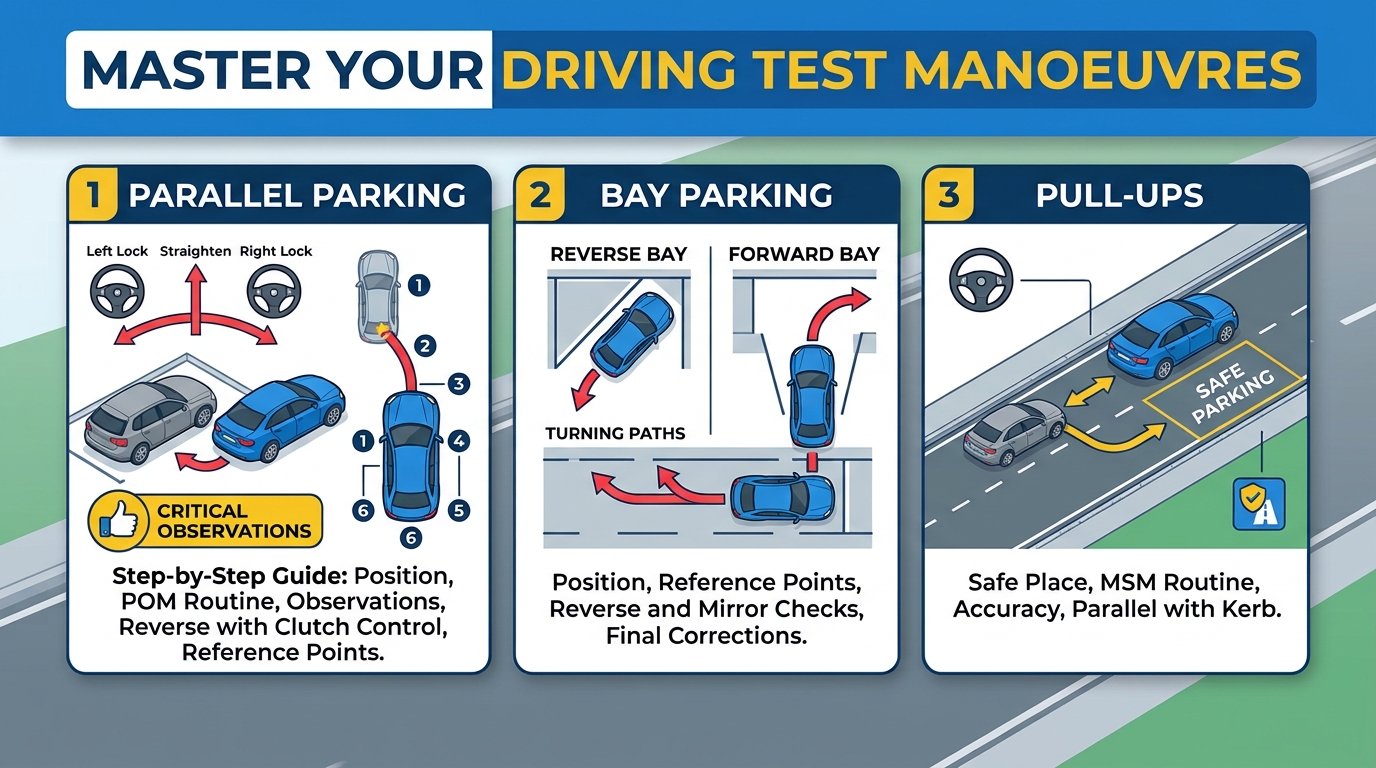
When learning to drive in the UK, few topics cause as much anxiety as the dreaded manoeuvres section of the practical driving test. Among them, parallel parking is often viewed as the ultimate test of car control, spatial awareness, and precision

Book Lessons

Pass Easily in South West London

Ditch the gears. Learn automatically in your local postcodes with expert ADIs.


However, with the right guidance, clear reference points, and a calm mindset, these manoeuvres become second nature. In this guide, we break down Parallel Parking, Bay Parking, and Pull-Ups step-by-step so you can approach your UK driving test with absolute confidence
Postcodes Covered

SM4

SW15 

SW19 

SW13 

SW18 

SW20 

1. How to Master Parallel Parking for Your Driving Test

During your practical test, the examiner may ask you to perform a reverse parallel park behind a vehicle parked on the left. You will typically be given a space roughly the size of two car lengths.

Step-by-Step Parallel Parking Guide:

  • Step 1: The Setup & Observations (POM Routine)

    Signal left and pull up alongside the target vehicle. Leave a lateral gap of about 0.5 to 1 metre between your car and theirs. Align your door mirrors roughly level with the front of the target car (or use your instructor’s specific reference point). Secure the car with the handbrake and select reverse gear.

  • Step 2: All-Around Checks

    Before moving, perform thorough observations. Check your interior mirror, left wing mirror, right wing mirror, and look over both shoulders for pedestrians, cyclists, and oncoming traffic.

  • Step 3: The First Reverse (Straight)

    Keep your steering straight and begin reversing at a ultra-slow walking pace using clutch control. Look mainly through your rear window. Stop when the back of the target car appears in your rear passenger window (or when your rear bumpers are level).

  • Step 4: Full Lock Left

    Turn your steering wheel one full turn (or full lock depending on your training method) to the left. Continue reversing slowly while checking your blind spots and mirrors. Your car will enter the space at roughly a 45-degree angle.

  • Step 5: Straighten and Lock Right

    When the kerb appears in your left wing mirror (or your car reaches the sweet spot), quickly straighten your wheels briefly, then apply full lock to the right as the front of your car clears the target vehicle. This swings your front end neatly towards the kerb.

  • Step 6: Final Adjustment

    As the car becomes parallel to the kerb, straighten your wheels. Stop smoothly, apply your handbrake, and secure the vehicle. Aim for a final distance of about 30cm from the kerb.

Top Tip: Minor corrections are fully permitted on the test! If you feel too close to the kerb or crooked, you can safely pull forward with opposite lock and try again, as long as you maintain observation safety.

2. Bay Parking: Reverse vs. Forward

Bay parking is another core skill tested across UK car parks. You may be asked to drive forward into a bay and reverse out, or reverse directly into a bay.

Reverse Bay Parking:

  1. Positioning: Drive past the bay, keeping about 1.5 to 2 car widths’ distance from the bays on your chosen side so you have room to swing.

  2. Signals & Observations: Check all mirrors and blind spots. Signal your intention if other cars are around.

  3. Reference Point: Line your body or shoulder up with a specific bay line designated by your instructor.

  4. Full Lock & Reverse: Select reverse, apply full steering lock toward the bay, and control your speed with the clutch. Monitor both wing mirrors equally to ensure you stay central between the white lines.

  5. Straighten Up: Once your car is parallel to the bay lines, straighten your steering wheel and reverse back until your tyres gently meet the stop-block or you are fully inside.

3. Safe and Controlled Pull-Ups (On the Right & Normal Stops)

The DVSA test also assesses how safely you can pull up on the right-hand side of the road (reversing back for two car lengths) as well as normal everyday stops.

Key Rules for Pulling Up Safely:

  • MSM Routine: Always use Mirrors – Signal – Manoeuvre well in advance.

  • Spotting a Safe Place: Avoid pulling up over driveways, near sharp corners, opposite school gates, or blocking visibility.

  • Accuracy: When pulling up on the right, your vehicle must stop parallel to the kerb without mounting it, leaving a sensible gap for traffic to pass safely.

Final Thoughts from Admire Driving School

Passing your driving test isn't about perfection; it’s about safety, awareness, and control. Examiners want to see that if you make a tiny miscalculation, you recognize it, pause, check your surroundings, and fix it safely. Want to perfect your parallel parking under professional guidance? Book your driving lessons with Admire Driving School today, and let our expert instructors help you pass on your very first attempt!

Latest News

Catch up on important updates, driving tips, and announcements from Admire Driving School to stay informed and ahead on the road.